
- Log in to post comments
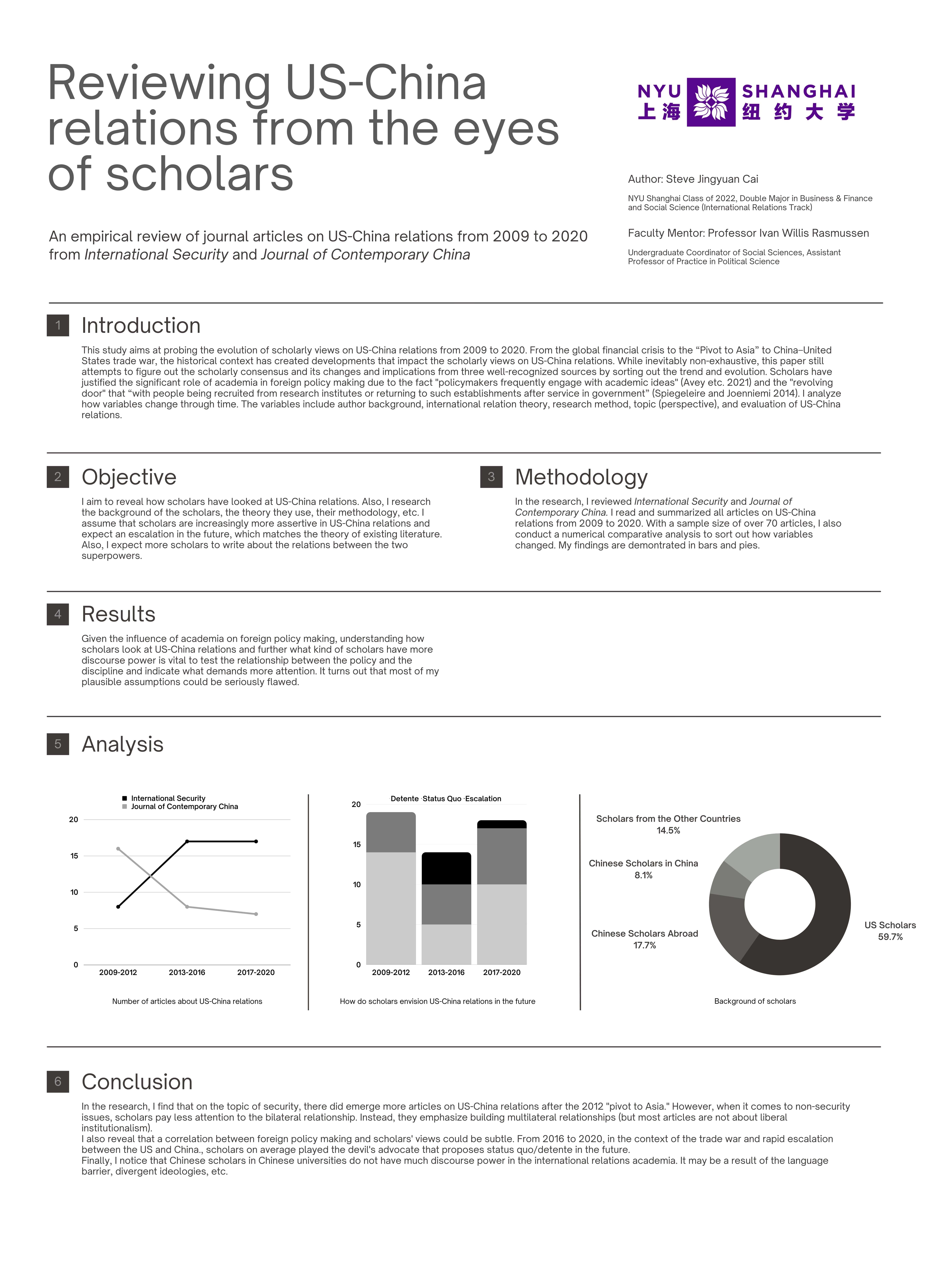
This study aims at probing how the academia has viewed US-China relations from 2008 to 2020. From the global financial crisis to “Pivot to Asia” policy to the Sino-US trade war, the historical context has created developments that impact the scholarly interpretation on US-China relations. While inevitably non-exhaustive, this paper still attempts to reveal if there exists a scholarly consensus of US-China relations from two well-recognized sources by sorting out the trend and elaborating on several phenomenally influential articles. I will first justify the significant role of academia in the foreign-policy making process. And after figuring out the scholarly consensus of the US academia, I will analyze how variables change through time. The variables include international relation theory, research method, topic (perspective), and threat level of China.
The paper aims to answer the following questions: do scholars share a consensus of the view of US-China Relations in the past decade? If so, what is the scholarly consensus and how has it evolved throughout the decade? Can we infer an indication of scholarly consensus in the next four years under the Biden administration?
Albeit China’s challenge, the US remains the hegemon of the status quo. Under the Pax Americana order, it is essential to learn how the scholarly consensus has evolved. The geographic focus of the academia also pivots more towards East Asia/China after the Cold War, especially under the Obama administration. Also, learning about the IR scholarly consensus helps us understand and even predict American foreign policies better.
Scholars have elaborated on how academia may affect US foreign policy making. According to Stephan de Spiegeleire and Pertti Joenniemi, the relationship between policy making and research in foreign and security policies is closer in the US than the one in Europe due to the “revolving door” “with people being recruited from research institutes or returning to such establishments after service in government”. Jacobs and Page argue that impacts of experts and epistemic communities “are quite substantial” on policy makers based on a cross-sectional and time-lagged quantitative analysis. They recognize the importance of business groups as well. However, business leaders seldom publish well-organized arguments of Sino-US relations, or due to interest conflicts, tend not to publicly claim them. Avey etc. claim that “policymakers frequently engage with academic ideas,” and “scholarly findings can shift their views.” Through the survey, they also find that “consensus is a factor in scholarly influence on policy practitioners” while “IR remains a contentious field.” This enhances the role of scholarly consensus. Thus, the insights from academia have a certain influence on policy making.
The research is a review article and analysis of past scholarly research. Aiming to find out the scholarly consensus, I will focus on all articles about US-China relations from 2008 to 2020 from two sources: International Security and Journal of Contemporary China. My methods will include both qualitative method and literature review and also include comparative analysis on the latter part.
Comments
- Log in to post comments

This project examines how studies on US-China relations change over time by analyzing articles in two influential journals. Scholarly work may be shaped by and influence policy practice. Thus, this study has the potential to contribute to understanding changes in US-China relations. The research question is well-defined. The method is appropriate to address the research question. However, the presentation would be more informative if the author could provide key and concrete findings.