
- Log in to post comments
Aim 1: To Observe How Regeneration in Young Immature Leaves is Affected by the Presence of a Pathogen in Mature Leaves
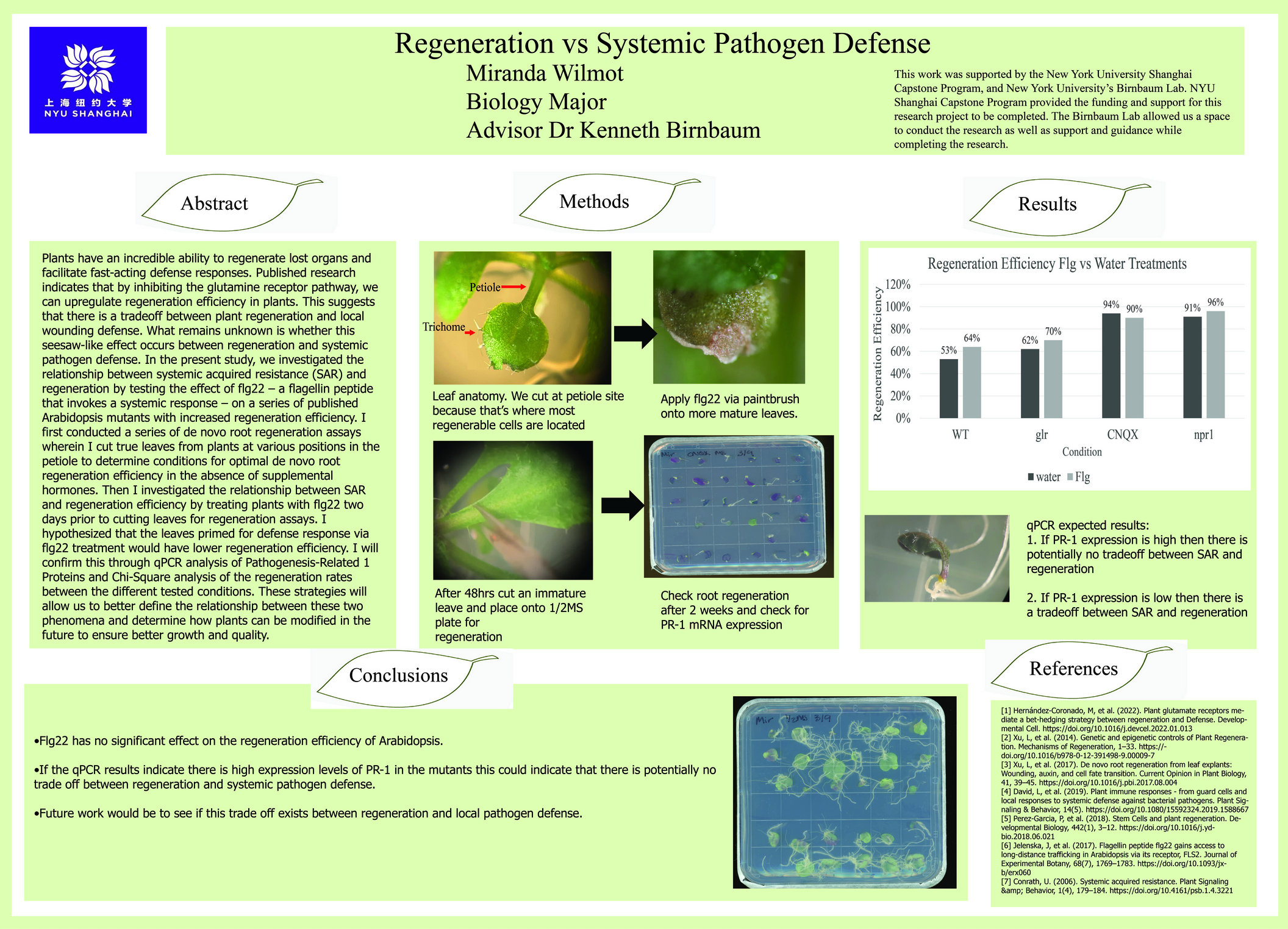
Rationale: The goal of this aim is to better understand the relationship between systemic acquired resistance and regeneration efficiency. I will perform two sets of experiments to define this relationship. The first experiment will be establishing the optimal conditions for regeneration in Arabidopsis. While the second experiment will be investigating the relationship between SAR and regeneration. This is important because it addresses the gaps from published work on developing higher order mutants to enhance regeneration in plants. The capability of the mutants to successfully establish similar to wild type levels of SAR response is unknown.
1.1: Establishing Conditions for Optimal Regeneration Efficiency in Wild Type Arabidopsis
The first part of this research will involve completing a regeneration assay to evaluate the optimal method of cutting immature leaves to invoke root regeneration in wild type Arabidopsis thaliana. I will be testing 5 different cut conditions. The cuts will be done on ten-day old Arabidopsis plants in a sterile environment using a dissecting microscope.
Expected Results/Rationale: Based on the data and experience of members from the Birnbaum lab, it is predicted that the best regeneration cuts will be ones that involve less of the petiole (part of the plant that attaches the leaf to the stem), while cuts that contain more of the petiole will lead to lower or no root regeneration.
1.2: Observing the Relationship Between Systemic Acquired Resistance and Root Regeneration
The second part of this aim is to investigate the relationship between SAR and regeneration. To do this another regeneration assay will be conducted. Ten-day old Arabidopsis plants will have their first set of true leaves exposed to flg22 in a sterile environment, then be placed back in the incubator for 2 days. After two days, the immature leaves from the second true leaf set will be cut, one leaf will be cut for regeneration using the cut method confirmed from aim 1.1, and the other leaf will be cut for a qPCR reaction to monitor the PR-1 expression levels. This experiment will include 4 different conditions. The first condition is wild type Arabidopsis. The second condition is a glr1.2/1.4/2.2/3.3 mutant, a higher order mutant that inhibits the GLRs and results in increased regeneration efficiency. The third condition is a npr1 mutant that prevents salicylic acid from binding with NPR1 during defense response and also results in increased regeneration efficiency. The final condition is placing the wild type Arabidopsis cut leaves on CNQX media. CNQX is a chemical inhibitor of the GLRs and has also been shown to improve regeneration efficiency
Expected Results: It is hypothesized that the mutants will have lower rates of regeneration efficiency since they are primed for defense before the cuts. It also hypothesized that the mutants would have a lower level of PR-1 expression than the wild type.
Comments
- Log in to post comments

It is a good and interesting study. One comment. It is better to include an illustration to explain SAR and regeneration in general and your rationale of the study. I can understand your studies after your explanation but not possible by reading your poster only. I am not sure whether general audience can follow it up.